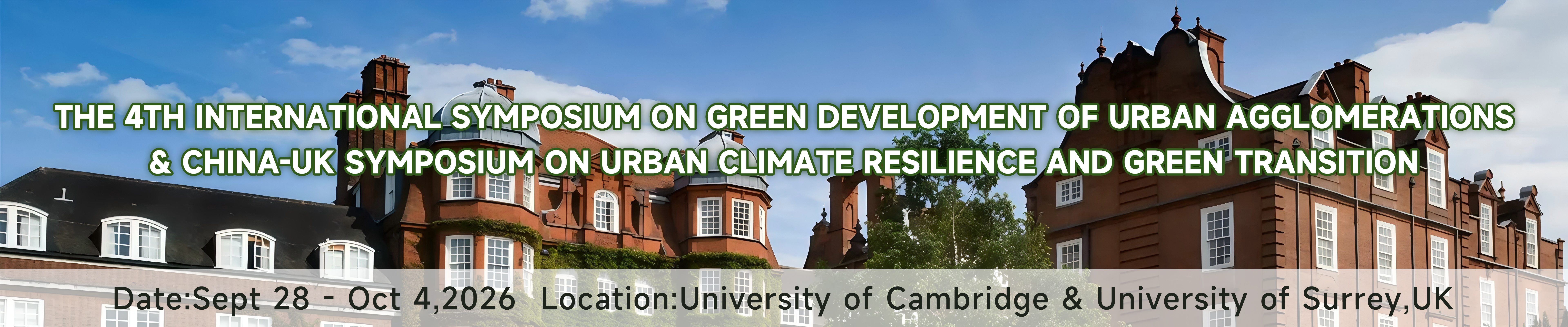
Parallel Session Agenda
Session 01 Data- and Model-driven Green and Low-carbon Urban and Regional Transition
29 September 2026 | Cynthia Beerbower Room (1), Newnham College
|
Time |
Programme |
|
19:30–21:30 |
Core research question How can data- and AI-driven models characterise climate risks and guide nature-based infrastructure and transport systems towards measurable gains in resilience, life-cycle decarbonisation and equitable access? |
|
Introductory Remarks: Kai Wang A Framework for the Sustainable Development of City Clusters and Metropolitan Areas Driven by Digital and Green Technologies——An Exploration of Methods for Regional Planning and Governance. |
|
|
Invited Speech (1) Fangzhu Zhang, University College London Title: Climate statecraft: governing low- carbon transitions in urban China. |
|
|
Invited Speech (2) Ying Jin, University of Cambridge Title: To be confirmed |
|
|
Invited Speech (3) Tao Yang, Tsinghua University Title: Spatiotemporal Intelligence-Driven Urban Regeneration |
|
|
Invited Speech (4) Hui Xu, China Academy of Urban Planning and Design Title: Digital Technology Empowers Spatial Optimization and Green Transformation in the Wuhan Metropolitan Area |
|
|
Session Speech (5) Mingwan Wu, Beijing Normal University Title: How Size Shapes Structure: Patterns and Mechanism in Urban Ecological Infrastructure |
|
|
Discussion Qianyi Luo, Urban Planner, China Academy of Urban Planning and Design (CAUPD) Explore how cities should act when AI predictions, local knowledge and community priorities diverge. Discuss acceptable levels of uncertainty, the role of human oversight, and who should be accountable when model-informed investments deliver uneven benefits. |
Session 02 Urban Ecological Development and Health Assessment
29 September 2026 | Millicent Garrett Fawcett Room, Newnham College
|
Time |
Programme |
|
19:30–21:30 |
Core research question Through which exposure pathways do emerging pollutants and environmental stressors affect urban health, and how can pollution control and ecological restoration achieve demonstrable reductions in these risks? |
|
Invited Speech (1) Yuansong Wei, Research Center for Eco-Environmental Sciences, Chinese Academy of Sciences Title: Optimization for an urban river ecological corridor width based on ecosystem services |
|
|
Invited Speech (2) Junya Zhang, Research Center for Eco-Environmental Sciences, Chinese Academy of Sciences Title: From Global Antimicrobial Footprints to Phage-Driven Precision Control: Mitigating AMR Risks for Urban Ecological Health |
|
|
Invited Speech (3) Zhengtao Zhang, Beijing Normal University Title: Global Heat Poverty: The Hidden Cost of Rising Temperatures |
|
|
Invited Speech (4) Pu Yang, University College London Title: Carbon Dioxide Removal: Equitable Allocation, Capacity Limits, and Policy Support |
|
|
Invited Speech (5) Zhuobiao Ni, South China Agricultural University Title: Enhancing Electrochemical Reductive Defluorination of PFASs Using Modified Cathode: Mechanistic Insights and Performance Optimization |
|
|
Session Speech (6) Jiaxi Wang, East China University of Science and Technology Title: Factors influencing PFAS accumulation in root and leafy vegetables under subsistence farming in Shanghai, China |
|
|
Session Speech (7) Ni Xue, Beijing Normal University Title: Cross-Scale Pathway-to-Reach (CSPR) Microplastic Modeling Framework for Resolving Source-to-Fate Attribution |
|
|
Session Speech (8) Xinyu Hao, Shanghai University of International Business and Economics Title: Decarbonization of global MSW management sector: What We Have Achieved and What Lies Ahead |
|
|
Discussion Examine when precautionary action is justified despite incomplete evidence, and how cities should prioritise protection for vulnerable populations. Discuss how to communicate uncertainty and involve affected communities in setting intervention priorities. |
Session 04 Pathways to Resource Efficiency, Circular Economy, and Building Energy Conservation and Carbon Reduction
29 September 2026 | Cynthia Beerbower Room (2), Newnham College
|
Time |
Programme |
|
19:30–21:30 |
Opening Remarks
|
|
Keynote Address Alessio Mastrucci, International Institute for Applied Systems Analysis (IIASA) Title: Building Low-Carbon Futures: Towards Resource-Efficient and Resilient Buildings and Cities |
|
|
Invited Speech (1) Lirong Liu, Centre for Environment and Sustainability, University of Surrey Title: Integrated Systems Modelling for a Just and Resilient Climate Transition |
|
|
Invited Speech (2) Fanxin Meng, Beijing Normal University Title: Future rooftop photovoltaics will weaken carbon mitigation but offer promising water and land benefits. |
|
|
Roundtable Discussion and Audience Q&A Moderator: Fanran Meng, University of Sheffield Panellists: Alessio Mastrucci, International Institute for Applied Systems Analysis (IIASA); Lirong Liu, University of Surrey; Raimondo Mancinelli, Costain Group; Yingyan Li, Arup. |
Session 05 AI-enabled Nature-based Infrastructure and Climate-adaptive Urban Development
30 September 2026 | Lecture Room 3, Inglis Building, Department of Engineering
|
Time |
Programme |
|
13:50–15:50 |
Core research question How can data- and AI-driven models characterise climate risks and guide nature-based infrastructure and transport systems towards measurable gains in resilience, life-cycle decarbonisation and equitable access? |
|
Invited Speech (1) Yangfan Li, School of Environment and Ecology, Xiamen University Title: Heatwave-Driven Exposure in the Blue Economy of Coastal Urban Agglomerations and Implications for Climate Resilience |
|
|
Invited Speech (2) Dawei Yu, Research Center for Eco-Environmental Sciences, Chinese Academy of Sciences Title: BSM2-ARG: A Plant-Wide Model for Quantifying Antibiotic Resistance Genes in Municipal Wastewater Treatment Plant |
|
|
Session Speech (3) Yuyang Ye, Beijing Normal University Title: Structural reorganization of physical climate risks to global thermal power systems under warming scenarios |
|
|
Session Speech (4) Xinyu Huang, Sun Yat-sen University Title: From Multi-objective Assessment to Decision-support Gaps: A Review of Decision-support Tools for Urban Nature-based Solutions |
|
|
Session Speech (5) Lanya Zhang, Beijing Normal University Title: Beyond economic incentives:how loss-aversion shapes local governments' response to green finance in urban blue-green infrastructure |
|
|
Session Speech (6) Xinxin Shang, Beijing Normal University Title: A Paradigm Shift in Carbon Sink Valuation: Unveiling a New Dynamic and Differentiated Ecological Compensation Mechanism for Urban Agglomerations |
|
|
Discussion Explore how cities should act when AI predictions, local knowledge and community priorities diverge. Discuss acceptable levels of uncertainty, the role of human oversight, and who should be accountable when model-informed investments deliver uneven benefits. |
Session 06 Place-specific Precision Eco-environmental Management in Urban Agglomerations
30 September 2026 | Lecture Room 3A, Inglis Building, Department of Engineering
|
Time |
Programme |
|
13:50–15:50 |
Core research question How do spatial restructuring and interregional dependencies shape urban resilience and environmental inequalities, and how can place-specific and cross-regional governance support urban transitions within ecological limits? |
|
Invited Speech (1) Li Wei (Online participation), Beijing Normal University Title: Developing a zoning strategy for net-zero carbon emissions of Chinese data centers |
|
|
Invited Speech (2) Ligang Lyu, Nanjing University of Finance and Economics Title: To be confirmed |
|
|
Session Speech (3) Gengyuan Liu, Beijing Normal University Title: An Integrated Study on Collaborative Carbon Mitigation Pathways between the Steel Industry and Cities from an Industry–City Integration Perspective |
|
|
Session Speech (4) Yin Zhang, Institute of Urban Environment, Chinese Academy of Sciences Title: Temperature Response and Regional Heterogeneity of Takeaway Freshly Made Beverage Consumption across Two Chinese Urban Agglomerations |
|
|
Session Speech (5) Qipeng Deng, Beijing Normal University Title: Urban Heat Stress Assessment Based on Large-Scale Physical Simulation and Explainable Machine Learning |
|
|
Session Speech (6) Mai Su, Tsinghua University Title: Can Ecological and Environmental Zoning-based Regulation Be Transmitted Across Regions Through Industrial Networks? |
|
|
Session Speech (7) Ke Zhang, Beijing Normal University Title: Carbon–Nitrogen–Phosphorus Multielement Metabolic Networks in the Guangdong–Hong Kong–Macao Greater Bay Area: A Resilience Perspective |
|
|
Session Speech (8) Peize Wang, Beijing Normal University Title: China’s west-to-east hydrogen system may intensify interprovincial water–carbon inequalities |
|
|
Discussion Explore how regions with unequal resources, bargaining power and transition costs can reach durable agreements. Discuss compensation, benefit-sharing and dispute-resolution arrangements, and how cooperation can remain effective across political and budget cycles. |
Session 07 Innovations in urban and regional ecological management for climate resilience
30 September 2026 | Lecture Room 3B, Inglis Building, Department of Engineering
|
Time |
Programme |
|
13:50–15:50 |
Core research question How can urban regions manage resource metabolism, nexus interactions and interdependence within ecological limits? |
|
Invited Speech (1) Jing Zhang, Department of Biology & Environmental Change Institute, University of Oxford Title: A Compass for Sustainable Food Systems Transformation: From Stakeholder Perspectives to an Integrated Framework |
|
|
Invited Speech (2) Hao Zhang, Department of Land Economy, University of Cambridge Title: Behavioural Mechanisms: the Missing Layer in Sustainable Transport |
|
|
Session Speech (3) Dan Qiao, Guangdong University of Technology Title: Assessing Urban Agglomeration Resilience through Carbon Metabolism Networks |
|
|
Invited Speech (4) Qing Li, Research Institute for Eco-civilization, Chinese Academy of Social Sciences Title: Long-Term Effects of the Carbon Border Adjustment Mechanism on Energy Substitution in Chinese Export Products to the European Union |
|
|
Session Speech (5) Qianyuan Huang, Guangdong University of Technology Title: Workplace heat exposure exacerbated the inequity of heat exposure across urban inhabitants: a big-data investigation in Shenzhen, China |
|
|
Session Speech (6) Meirong Su, Yuan Zhang, Guangdong University of Technology Title: Heatwave legacies reshape storm runoff generation under compound climate extremes |
|
|
Discussion
1. How can big data and AI tools facilitate climate-adaptive and low-carbon urban systems? |
Session 08 AI-based Sustainable Urban Transport Systems
30 September 2026 | Lecture Room 3, Inglis Building, Department of Engineering
|
Time |
Programme |
|
16:00–19:00 |
Core research question How can data- and AI-driven models characterise climate risks and guide nature-based infrastructure and transport systems towards measurable gains in resilience, life-cycle decarbonisation and equitable access? |
|
Invited Speech (1) Wenlong Shang, Imperial College London Title: Traffic Signal Control with Deep Reinforcement Learning Toward Enhanced Resilience of Urban Road Networks |
|
|
Invited Speech (2) Mengqiu Cao, University College London Title: Revolutionising Last-Mile Logistics: An Evaluation of the Potential and Impacts of Autonomous Delivery Robots in the UK |
|
|
Session Speech (3) Zhengmao Li, Aalto University Title: AI-Driven Two-Stage Electric Vehicle Charging and Routing Optimization for Sustainable Urban Transportation Systems |
|
|
Session Speech (4) Yitong Shang, University of Cambridge Title: AI-Enabled Spatiotemporal Data Fusion for Urban Electric Vehicle Charging Demand Forecasting |
|
|
Session Speech (5) Yajing Xiao, University of Leicester Title: AI-Driven Architecture Design and Safe Energy Management for Sustainable Hydrogen-Electric Urban Air Mobility |
|
|
Session Speech (6) Bozheng Li, University of Sheffield Title: Low-Carbon Operation of Electric Urban Air Mobility with Logistics Energy Systems: A Multi-Agent Reinforcement Learning Framework |
|
|
Invited Speech (7) Yifan Wen, Beijing Normal University Title: Substantial But Unequal Health Benefits from Electric Vehicles Adoption Across Chinese Cities |
|
|
Invited Speech (8) Xinyao Song, University College London Title: Retirement Migration and Age-Friendly Greenways: Evidence from Sanya, China |
|
|
Discussion Explore how cities should act when AI predictions, local knowledge and community priorities diverge. Discuss acceptable levels of uncertainty, the role of human oversight, and who should be accountable when model-informed investments deliver uneven benefits. |
Session 09 Exploring Health–Environment–Emergy Coupling
30 September 2026 | Lecture Room 3A, Inglis Building, Department of Engineering
|
Time |
Programme |
|
16:00–19:00 |
Core research question How do resource-metabolism networks and cross-regional dependencies shape ecological overshoot and urban resilience, and under what conditions can nexus-based interventions reduce pressures without displacing them across sectors or regions? |
|
Invited Speech (1) Sergio Ulgiati (Online participation), University of Naples Parthenope Title: Are urban trees a real source of environmental services? An emergy evaluation of urban forests management and development (costs and benefits) within the perspective of climate change. |
|
|
Invited Speech (2) Silvio Cristiano, University of Florence Title: EMergy and systems thinking for stronger urban sustainability, health, and climate resilience |
|
|
Invited Speech (3) Xi Tian, Nanchang University Title: Reducing the environmental impacts of battery recycling through spatial and technological alignment |
|
|
Session Speech (4) Menghan Guo, Beijing Normal University Title: Multiscale Spatial Mismatch between Urban Population-Time Use and Green Environments: Evidence from Mobile Signaling Data in Beijing |
|
|
Session Speech (5) Wenfang Gao, Hebei University of Technology Title: Prediction and Analysis of Spent Lithium-Ion Battery Recovery Process Based on Machine Learning |
|
|
Session Speech (6) Jinye Niu, University of Sheffield Title: Unveiling the Dynamics of Land Use Intensity for Photovoltaic (PV) Plants in China |
|
|
Session Speech (7) Leili Abolhassani, Ferdowsi University of Mashhad Title: Global Assessment of Agricultural Sustainability Using Emergy-Based Indicators |
|
|
Session Speech (8) Fei Peng, Nanchang University Title: Large-scale Application of Photovoltaic Direct-Drive PoE Lighting in Nearly Zero-Carbon Buildings |
|
|
Invited Speech (9) Francesco Gonella, Ca' Foscari University of Venice Title: Exploring Health–Environment–Emergy Coupling |
Session 10 Regionally Connected Urban Socioeconomic and Ecological Systems
30 September 2026 | Lecture Room 3A, Inglis Building, Department of Engineering
|
Time |
Programme |
|
16:00–19:00 |
Core research question How do spatial restructuring and interregional dependencies shape urban resilience and environmental inequalities, and how can place-specific and cross-regional governance support urban transitions within ecological limits? |
|
Invited Speech (1) Qiang Yang, University College London Title: Regional planetary boundary transgressions are structural not distributive |
|
|
Session Speech (2) Shiting Li, School of Ecology, Environment and Ocean, Guangdong University of Technology Title: Synergies or Trade-offs? Spatial Structure Transformation and Land-Use Metabolism in Urban Agglomerations |
|
|
Session Speech (3) Mingxue Zhu, Beijing Normal University Title: From Planetary Boundaries to Overshoot Networks: Reframing Resilience Assessment for Urban Agglomerations |
|
|
Session Speech (4) Yuqi Xing (Online participation), Beijing Normal University; Loughborough University Title: Macro-level Improvement and Micro-level Gap: Impact of Land Factor Allocation on Urban Economic Resilience under Urban Renewal |
|
|
Invited Speech (5) Heran Zheng, University College London Title: Sustainable Production and Consumption from Data to Applications |
|
|
Discussion Explore how regions with unequal resources, bargaining power and transition costs can reach durable agreements. Discuss compensation, benefit-sharing and dispute-resolution arrangements, and how cooperation can remain effective across political and budget cycles. |
Session 11 Integrated Urban and Regional Water–Energy–Food–Carbon Management
30 September 2026 | Lecture Room 3B, Inglis Building, Department of Engineering
|
Time |
Programme |
|
16:00–19:00 |
Core research question How do resource-metabolism networks and cross-regional dependencies shape ecological overshoot and urban resilience, and under what conditions can nexus-based interventions reduce pressures without displacing them across sectors or regions? |
|
Invited Speech (1) Huihui Long, The University of Manchester Title: Satellite-based global monitoring of urban-scale methane emissions |
|
|
Invited Speech (2) Hui Jiang, Beijing Normal University Title: Integrating Ecological and Social Service Assessment of Urban Nature-based Solutions in Beijing Lianshihu Park: A Multi-Model Approach |
|
|
Session Speech (3) Xinqing Li, College of Environment and Resources, Xiangtan University Title: Unraveling resilience of urban food-energy-water security under the changing environment |
|
|
Session Speech (4) Lu Li, Beijing Normal University Title: Evolution and Obstacle Diagnosis of Urban Resilience from a Water-Energy Nexus Perspective |
|
|
Session Speech (5) Yuchen Xie, Sun Yat-sen University Title: Consumption side pathways for carbon mitigation and urban rural inequality across Chinese cities |
|
|
Session Speech (6) Xuanru Zhou, Beijing Normal University Title: Biodiversity costs and delayed benefits of China's rare earth supply chain for green technologies |
|
|
Discussion Consider how cities and regions should allocate limited resources between essential services, economic activity and ecosystem needs. Debate what constitutes a fair allocation, whose demands should take priority during shortages, and how resource-dependent regions can share responsibilities. |




{{ 'en' == 'cn' ? item.name : item.name_en }}
{{ 'en' == 'cn' ? item.desc : item.desc_en }}